Amidst public outcry in support of immigration reform that protects dreamers and puts forth common sense gun control members of Congress continue to grapple over these issues with no real measurable steps forward. When it comes to debating these polarizing issues Congress men and women seem to be caught in a never-ending stalemate. The author of this New York Times article attributes this common scenario in politics to the fact that our government is being run by Republicans that are mainly concerned with serving the interests of their constituents who tend to hold minority sentiments on legislation about immigration and gun measures. For example, recently when Senator Mitch McConnell succumbed to public pressure and allowed for a vote on immigration proposals, all hope for any agreement was lost when the administration criticized the bipartisan plan that "would have given Dreamers-but not their parents-a path to citizenship in exchange for $25 billion" to be spent on a southern border wall because the President also wanted more stringent limits on family based migration. As long as our leaders continue to bend to the will of their constituents rather than serving the rest of America I fear that we will continue to see progress halted when it comes to voting and ratifying legislation that could possibly save lives.
https://www.nytimes.com/2018/02/22/us/politics/gun-control-immigration-legislation.html?hp&action=click&pgtype=Homepage&clickSource=story-heading&module=first-column-region®ion=top-news&WT.nav=top-news
Wednesday, February 28, 2018

Wednesday, February 21, 2018
DACA in Dalton
The residents of Dalton, Georgia, a place where Donald Trump won more than 70% of the vote in 2016, are keeping a watchful eye over the debates concerning immigration. Specifically businesses that employ immigrants because despite businesses booming there, they are experiencing a labor shortage and many of the people that are still willing to work in these factories are DACA recipients. In this npr article the president of the Greater Dalton Chamber of Commerce, Rob Bradham, is quoted saying "DACA is a big issue for us... Just because they're valuable employees to our industries and we don't want to lose them". A major industry in Dalton is the carpet industry which most of the carpet sold in America comes from Dalton. As a matter of fact, after World War II wall-to-wall carpeting was invented there and Dalton refers to itself as the "carpet capital of the world". Although business owners quoted in this article support Trump because they believe he is good for business, they are becoming increasingly nervous due to the uncertainty of his immigration policies.
Community leaders are worried about how the local economy and businesses will be impacted if there were to be a significant loss in their present labor force as a result of potential ICE raids. Thomas Homan, the acting director of ICE has declared that "this year you're gonna see a significant increase in worksite enforcement". As we have already seen by the 7-11 raids, ICE is putting their director's words into action. Not only are employers nervous about the future, but many immigrant families living and working in Dalton are nervous and fearful too.
https://www.npr.org/2018/02/19/585770437/why-employers-in-georgia-are-watching-the-immigration-debate-closely
Tuesday, February 13, 2018
Kumbaya
In 1926 H. Wylie, a Gullah Geechee man, made the first ever recording of the folk song kumbaya in Darien, Georgia. The Gullah Geechee people whose enslaved ancestors were brought to the southeastern coast of America from West Africa. In an effort to promote and preserve the Gullah culture and land that has been under threat by rising property values, residents lobbied Congress to acknowledge the origins of this hymn, and two months ago representative Buddy Carter recognized this culture's contribution to American History.
The historical context of kumbaya is that the chorus is actually "Come by Here", calling for God to help these oppressed people, but as John Eligon writes because of the "Gullah's Creole accent sounds like cum-by-yah. Over time, that pronunciation transformed into what we know today as kumbaya".
The article has the recording of the original 1926 version sang by H. Wylie that is kept at the American Folklore Center at the Library of Congress, but some of the lyrics are:
Kumbaya my Lord, Kumbaya my Lord, kumbaya
Someone's singing Lord, kumbaya. Someone's singing Lord, kumbaya.
Someone's laughing Lord, kumbaya. Someone's laughing Lord, kumbaya.
Someone's crying Lord, kumbaya. Someone's crying Lord, kumbaya.
Link:
Tuesday, February 6, 2018
City College and Citizenship
In the San Francisco Chronicle Jenna Lyons wrote about how City College in San Francisco offers the use of it's rooms on campus to the SF Pathway to Citizenship Initiative, so they can provide free assistance to anyone trying to navigate the citizenship process. The workshop walks people through the four to five step process that takes about two hours. The workshop is funded by the Office of Civic Engagement and Immigrant Affairs and Volunteers are attorney's that offer pro bono services, citizens that obtained their citizenship through this workshop, and other professionals. Also, translators are on site and they speak Mandarin, Cantonese, Tagalog, Spanish, Russian, Arabic, and Vietnamese. While going through the process at the workshop, if a person finds out that they may not be eligible for full citizenship at the time, then the attorneys offer one-on-one consultations with him/her to see if they qualify for other legal statuses, like holding a green card. According to this article, this workshop has been operating for five years and is being supported by the city and Mayor Mark Farrell himself.
 Picture from the event and posted on the article webpage.
http://www.sfchronicle.com/bayarea/article/Path-to-citizenship-goes-through-SF-City-College-12549254.php#photo-14987357
Picture from the event and posted on the article webpage.http://www.sfchronicle.com/bayarea/article/Path-to-citizenship-goes-through-SF-City-College-12549254.php#photo-14987357
Tuesday, January 30, 2018
Germany's Renewed Fight Against Anti-Semitism
The article that I read from the New York Times is about the rise of immigrants coming to Germany, many of whom are from Africa and Middle East, fleeing war and environmental problems, like drought and famine. Sawsan Chebli, a German politician, attributes a portion of the rise in anti-semitism to the new immigrants, but some German historical scholars argue that the new immigrants are not to blame for the rise in anti-semitic views.
Each side of the argument wants to see this xenophobic problem resolved within their country. Ms. Chebli proposed the idea of mandatory visits to concentration camps for people new to the country. She hopes, as do those who are in agreement with her, that these visits would be a warning of the harm unleashed hatred is capable of inflicting. On the other hand, the director of the Center for German and European Studies at the Brandeis University, Sabine Von Mering, contends that one visit to a memorial will not solve the deep rooted-issues that exist in Germany, which stem from their past.
Unfortunately, this issue is neither new, nor is it isolated. All over the world there seems to be a rise in nationalistic ideals and so is the desire to attribute the problems a country is facing to a particular group. The problems of hatred and fear of the other will not be solved overnight, we must grapple over how to reach a long lasting, sensible solution that will create peace within each nations people and the world beyond.
https://www.nytimes.com/2018/01/10/world/europe/germany-immigrants-anti-semitism.html?action=click&contentCollection=world®ion=rank&module=package&version=highlights&contentPlacement=2&pgtype=sectionfront
Tuesday, January 23, 2018
U.S. Rates of Naturalization
According to the PEW Research Center, the number of immigrants becoming United States naturalized citizens has increased between 2005 and 2015. The top two countries of origin in which naturalization rates are the highest at a 12 percentage point increase are Ecuador and India, followed by Peru, Haiti, both at 9 percent, and Vietnam at 7 percentage points. The article goes on to say that immigrants from countries nearest to the U.S., like Canada and Mexico, are less likely to pursue citizenship because they "are more likely to maintain strong ties to their countries of origin, increasing the likelihood that they move back to their home country" (PEW). Also, obtaining citizenship is an expensive, lengthy process and those two facts alone are major barriers to eligible persons wanting to apply for citizenship.
PEW Chart: Naturalization rates up among most immigrant groups in the U.S. since 2005
 http://www.pewresearch.org/fact-tank/2018/01/18/naturalization-rate-among-u-s-immigrants-up-since-2005-with-india-among-the-biggest-gainers/
PEW Chart: Naturalization rates up among most immigrant groups in the U.S. since 2005
Tuesday, January 16, 2018
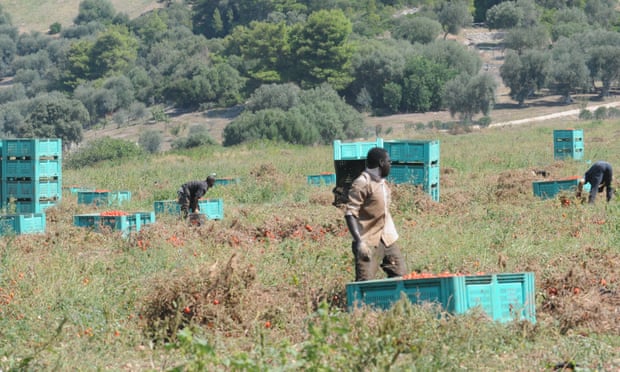
Migrant Workers in Italian Tomato Fields
The company Princes, which is owned by the Mitsubishi corporation, is the main supplier of tomatoes in the UK. According to The Guardian, Princes has been named in an investigation focused on revealing and stopping labor abuses by the tomato supplier De Rubertis. De Rubertis farms are accused of illegally forcing workers to work twelve hour shifts in the fields all week long with little to no breaks and very little pay. Mutti and Conserve Italia were also named as beneficiaries to the exploitative, horrible labor conditions of the tomato industry, but have parted ways with the De Rubertis farm once news broke about the inquiry.
The death of Abdullah Muhammed, a middle-aged legal Sudanese immigrant and seasonal laborer, in 2015 is what spurred the initial inquiry into the labor practices of these tomato companies because the prosecutor argued that Mr. Muhammed's heart attack, leading to is untimely death, could have been prevented if he had been given medical treatment. Unfortunately, this story of a man dying due to unfair labor practices is not an isolated one. All over the world, including in the U.S., immigrants and migrant laborers are frequently taken advantage of by people in high positions of economic power, which is a shame because most if not all of the workers are good, dedicated people who want to have a better life.
Photo from the article
Link
https://www.theguardian.com/global-development/2018/jan/12/italian-tomatoes-food-firm-princes-linked-to-labour-abuses-inquiry
The death of Abdullah Muhammed, a middle-aged legal Sudanese immigrant and seasonal laborer, in 2015 is what spurred the initial inquiry into the labor practices of these tomato companies because the prosecutor argued that Mr. Muhammed's heart attack, leading to is untimely death, could have been prevented if he had been given medical treatment. Unfortunately, this story of a man dying due to unfair labor practices is not an isolated one. All over the world, including in the U.S., immigrants and migrant laborers are frequently taken advantage of by people in high positions of economic power, which is a shame because most if not all of the workers are good, dedicated people who want to have a better life.
Photo from the article
Link
https://www.theguardian.com/global-development/2018/jan/12/italian-tomatoes-food-firm-princes-linked-to-labour-abuses-inquiry
Subscribe to:
Posts (Atom)